


Duocentric-IC Gearing
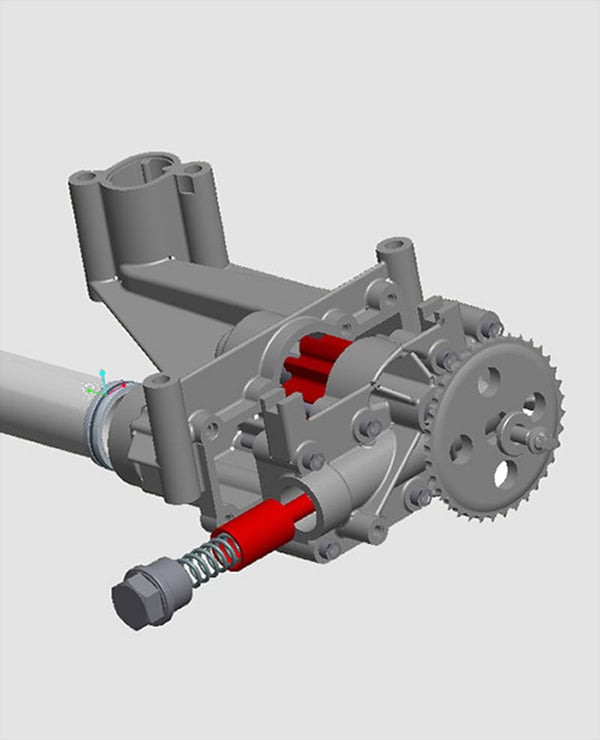
Duocentric-IC overcomes typical limitations of common gerotor designs. It delivers higher displacement in the same envelope, with lower noise emission and lower pressure pulsation —enabling compact, packaging-critical oil pump architectures and direct crankshaft mounting via the inner rotor.


Explore our engineering toolbox
Start with your key requirement and dive into the related expertise area in one click.


Optimized for every application
Clear deliverables at every stage, from concept to validated prototypes and production-ready transfer.


Validated performance. Documented transfer.
Every prototype is optimized on our prototype test rig for controlled flow delivery, low power consumption, stable pressure behavior, low pulsation, and low noise emission. Electric driven oil pump prototypes are typically available within 3–4 months after design freeze and are 100% tested with full test reports.
FAQs
Quick answers to common questions about oil pump custom development, timelines, validation, and how we support series ramp-up through production partners.
Because oil pump behavior directly affects pressure stability, lubrication reliability, NVH, efficiency, thermal management, and packaging. A pump that works well as a standalone component can still create problems when suction paths, oil viscosity, relief valve behavior, or system interfaces are not aligned.
Pressure pulsation can be caused by gear geometry, tooth engagement, leakage gaps, suction conditions, trapped oil volumes, relief valve oscillation, and interaction with the wider hydraulic circuit. Reducing pulsation requires both optimized pump design and system-level analysis.
Oil pumps consume mechanical or electrical power. If the pump delivers more flow or pressure than needed, energy is wasted. By optimizing displacement, leakage, pressure behavior, and regulation strategy, pump losses can be reduced and overall drivetrain efficiency can improve.
Potential measures include optimized gearing, improved clearances, smoother tooth engagement, suction path optimization, housing stiffness adjustments, and better pressure regulation behavior. TPV evaluates which changes are possible within the existing packaging and interface constraints.
Often, yes. Compact packaging can be addressed through gear set optimization, adapted housing design, direct integration, improved suction positioning, and application-specific mounting concepts. The key is to define packaging and hydraulic requirements together, not separately.
Simulation and calculation are not enough to fully predict real oil pump behavior. Prototype testing helps verify flow, pressure stability, pulsation, leakage, noise, power consumption, relief valve behavior, and thermal influence before the concept moves toward production preparation.